Posts Tagged ‘egypt’
Why you should ignore crowd estimates

(Miguel Medina / AFP - Getty Images)
Cross-posted from World Blog. Read this post in context.
Update 1:10 p.m. ET: Al-Jazeera has now cut its estimate in half. Earlier: “up to two million.” Now: “more than a million.”
Wired, meanwhile, offers a way to guesstimate a big crowd.
_____
Estimating crowds is a notoriously inexact science, so much so that the National Park Service stopped doing it for protests in Washington many years ago. That leaves it up to news organizations to make their best guesses.
So it’s no surprise that estimates of the crowd that gathered today in Cairo’s Tahrir Square are very imprecise and wide-ranging:
• Washington Post: “Tens of thousands, perhaps hundreds of thousands.”
Live-blogging Egypt
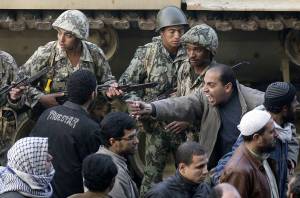 I’m live-blogging the protests in Egypt today for msnbc.com’s World Blog. Here’s a roundup to get you started.
Right: Egyptian soldiers and civilians gather Monday in Al Tahrir Square in central Cairo. (Felipe Trueba /EPA) Full slideshow.
‘This is about social networks that are beyond the reach of Mubarak’
 Cross-posted from Technolog: read in context
Large parts of the Internet essentially went dark about midnight Egypt time after the government of President Hosni Mubarak, a longtime ally of Washington, ordered service providers and cell phone companies to shut down.
While it looks like Egypt has been cut off — attempts to get to pretty much any Web site in Egypt are unsuccessful, and Twitter.com is unavailable inside the country — protesters and sympathizers have been able to get their message out through a variety of means because “what the government does is very effective for stopping the most basic users, meaning average users, the folks who probably aren’t Twitter users,” says Philip N. Howard, director of the Project on Information Technology and Political Islam at the University of Washington and author of “The Digital Origins of Dictatorship and Democracy: Information Technology and Political Islam.”
“Most of the folks who are tweeting are kind of the digital elite who can set up proxy servers and Twitter clients and get their message out,” he says. “It only takes a few thousand of those folks to feed the rest of us news about what’s going on.”
Here’s the text of our full conversation with Howard:


 Alex Johnson - Journalist at Large